How to Tell a Dog's Age by Its Teeth (+ Life Stage Chart)
If you've ever adopted a rescue dog with no paperwork, you've probably faced the same question every shelter volunteer and new owner asks: how old is this dog, really? Veterinarians have relied on teeth to estimate a dog's age for well over a century, and while it's not an exact science, a dog's mouth tells a surprisingly detailed story — from the order baby teeth fall out to how much tartar has built up over the years. This guide walks through that story stage by stage, including a few details most articles on this topic skip entirely: how breed affects the accuracy of this method, and how confident you can actually be in the estimate.
If your dog is still very young, our pet age calculator has a dedicated "By Weeks" mode built specifically for the age range covered in the next section — useful alongside the teeth-based signs below.
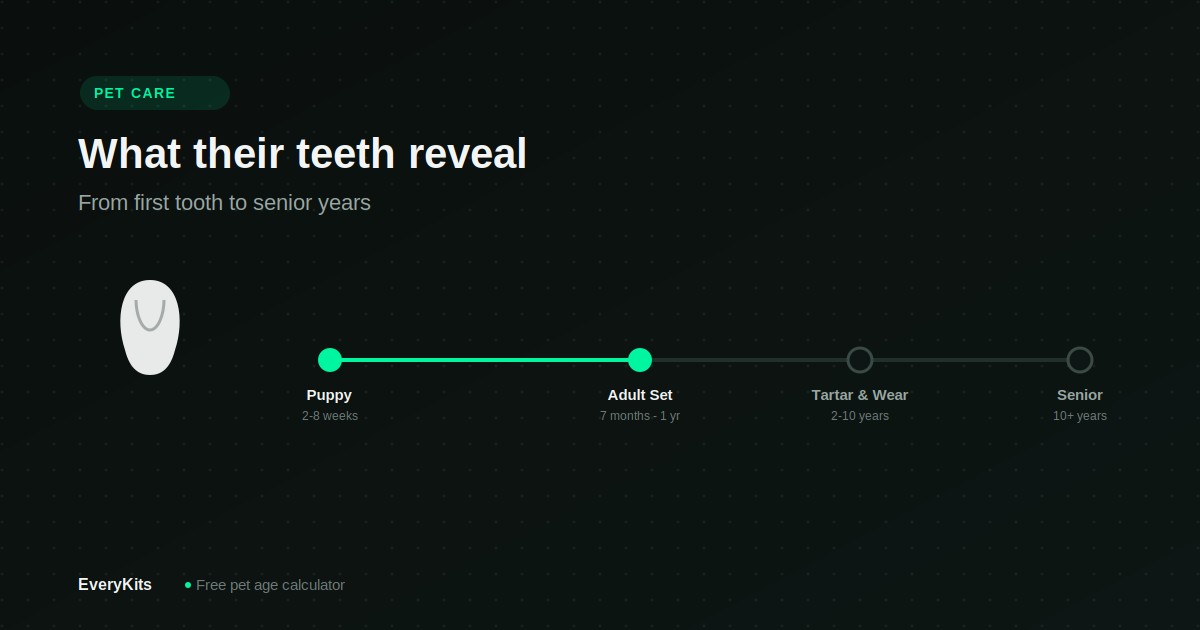
The Puppy Teeth Timeline (Weeks 2–8)
A puppy's baby teeth — properly called deciduous teeth — follow a fairly predictable schedule:
- 2–4 weeks old: the first baby incisors (the small front teeth) begin erupting.
- 3–5 weeks old: baby canines (the pointed "fang" teeth) come in next.
- 4–6 weeks old: baby premolars fill in toward the back of the mouth.
- By 6–8 weeks old: all 28 baby teeth are typically present, and no baby molars ever come in — molars are adult-only teeth.
This early window is actually the most reliable stretch for teeth-based age estimation, since the schedule is consistent enough that a vet (or a careful owner) can often narrow a young puppy's age down to within a week or two.
Losing Baby Teeth: The Adult Timeline (Months 3–7)
Somewhere around 3 to 4 months old, a puppy starts losing those baby teeth as permanent ones push them out — often noticed first as a gap where the front incisors used to be. From there:
- 4–6 months old: permanent canines erupt, alongside the ongoing replacement of premolars and incisors.
- By 6 months old: nearly all baby teeth should be gone.
- By 7 months old: most dogs have a full set of permanent teeth, fully or almost fully erupted.
- At 1 year old: all adult teeth are in, typically white and clean with no visible wear yet.
Worth noting: there's a real gap between 7 months and 1 year where teeth alone don't tell you much — the mouth looks essentially "done" for most of that stretch, so other signs (covered below) become more useful during this window.
One Year and Beyond: Wear, Tartar, and Color
Once all adult teeth are in, estimating age shifts from "which teeth are present" to "what condition are they in." This is where the method becomes noticeably less precise, but still useful in broad strokes:
- 1–2 years old: teeth may start to look slightly yellow as tartar begins forming.
- 2–5 years old: tartar buildup continues, and mild wear becomes visible on the biting surfaces.
- 5–10 years old: this is when wear and early gum disease become common — yellowing is more pronounced and tartar is thicker.
- 10+ years old (senior): it's common to see missing teeth from periodontal disease or old fractures, heavily worn or shortened incisors, and calculus so built up it can look dark yellow, brown, or nearly black at the tooth's base.
Quick Reference: Dog Age by Teeth Stage
- Weeks 2–8: Baby teeth erupting — most precise stage for estimating age
- Months 3–7: Baby teeth falling out, adult teeth coming in
- 1 year: Full adult set, white, no wear
- 1–2 years: Slight yellowing, early tartar
- 2–5 years: Visible tartar, mild wear
- 5–10 years: Noticeable wear, possible early gum disease
- 10+ years: Missing teeth, heavy staining, significant wear likely
Breed Differences Worth Knowing
Most teeth-based age guides treat every dog the same, which is misleading — dental disease and tooth wear don't progress at the same rate across breeds. Smaller breeds prone to crowded teeth and dental disease — pugs, Yorkshire terriers, greyhounds, poodles, and Maltese are commonly cited examples — tend to develop tartar and gum issues earlier than their actual age would suggest, and some may also lose baby teeth later than the typical schedule. In practice, this means a small-breed dog's teeth can make them look a couple of years older than they really are, while a large or giant breed with naturally spaced teeth might look a bit younger. If you know (or suspect) your dog's breed mix, it's worth mentally adjusting the estimate rather than taking the raw teeth-stage chart at face value.
Don't Rely on Teeth Alone
Teeth are one of the most useful age indicators a dog owner has access to, but veterinary professionals typically combine them with other physical signs rather than reading the mouth in isolation. Graying fur — especially around the muzzle and eyes — tends to appear from middle age onward. Reduced activity level and increased joint stiffness are common senior indicators, particularly in larger breeds. Eye clarity is another clue: a slight cloudiness (distinct from the more serious condition of cataracts) is common in older dogs and rare in young ones. None of these signs is precise on its own, but teeth plus two or three of these physical markers together give a noticeably more reliable estimate than any single indicator alone.
How Accurate Is This Method, Really?
Here's the honest answer most articles gloss over: teeth-based age estimation is highly reliable for puppies under 7 months old, thanks to the predictable eruption schedule, but it becomes progressively less precise after that. Once a dog is fully grown, you're really estimating a range — "somewhere between 4 and 6 years" rather than a single number — and that range widens further for senior dogs, since how quickly tartar and wear accumulate depends heavily on diet, chew habits, breed, and how consistently the dog has had dental care. If you need a genuinely precise age, a veterinary exam that combines dental assessment with other health markers is always more reliable than a teeth chart alone — this method is best treated as a solid estimate, not a verdict.
Frequently Asked Questions
Can you tell a dog's exact age from its teeth?
What age do puppies get all their adult teeth? Most puppies have a complete set of permanent teeth by around 7 months old, though the process of losing baby teeth and growing adult ones typically starts around 3 to 4 months.
Do small dog breeds show their age differently in their teeth? Yes. Breeds prone to dental disease — including pugs, Yorkshire terriers, greyhounds, poodles, and Maltese — often develop tartar and wear earlier than their actual age, which can make them look older by their teeth alone than a large breed of the same age.
Does this method work for cats too? The general principle is similar — cats follow a comparable baby-tooth-to-adult-tooth timeline, though it runs on a slightly faster schedule than dogs. The wear-and-tartar stages after adulthood follow the same broad pattern.
How do I calculate my puppy's exact age once I have an estimate from their teeth? Once you have a rough age estimate in weeks or months, the pet age calculator's "By Weeks" mode will convert that into a developmental stage and an approximate human-age equivalent — useful for figuring out what care and training milestones to expect next.
Get an Exact Number, Not Just a Range
Teeth tell you roughly how old your dog is — the pet age calculator takes that estimate and turns it into a clear human-age equivalent, whether you're working with a young puppy measured in weeks or an adult dog measured in years.


Comments
Comments coming soon! In the meantime, feel free to share your thoughts on social media.