Retirement Age by Birth Year: Full Chart & Explanation (2026)
"When can I retire?" sounds like it should have one simple answer, but it doesn't — your retirement age depends entirely on the year you were born. Two coworkers turning 66 in the same year can have completely different Full Retirement Ages if their birth years differ. This guide breaks down exactly how that works, gives you the full chart by birth year, and answers the specific "born in [year]" questions people search for most.
If you'd rather skip the reading and get your exact date, the EveryKits retirement age calculator works out your projected retirement date directly from your date of birth in seconds.
What Is "Full Retirement Age" (FRA)?
Full Retirement Age is the age at which you become eligible to receive 100% of your calculated retirement benefit — no reduction for claiming early, and no bonus for delaying. It's set entirely by your birth year, not by when you actually stop working or when you choose to claim benefits. The Social Security Administration set this schedule through the 1983 Social Security Amendments, which gradually raised FRA from 65 to 67 in stages over several decades to keep the system sustainable as life expectancy increased.
FRA matters for more than just your own retirement timing — it's also the reference point used to calculate spousal benefits and survivor benefits for family members, regardless of when benefits are actually claimed.
Full Retirement Age Chart by Birth Year
Here's the complete FRA schedule based on birth year:
- Born 1943–1954: Full Retirement Age is 66
- Born 1955: Full Retirement Age is 66 and 2 months
- Born 1956: Full Retirement Age is 66 and 4 months
- Born 1957: Full Retirement Age is 66 and 6 months
- Born 1958: Full Retirement Age is 66 and 8 months
- Born 1959: Full Retirement Age is 66 and 10 months
- Born 1960 or later: Full Retirement Age is 67
One technical quirk worth knowing: if you were born on January 1st of any year, Social Security treats you as if you were born in the previous year for FRA purposes. So someone born January 1, 1960 actually uses the 1959 schedule — an FRA of 66 and 10 months, not 67.
Answering the Specific Birth-Year Questions
Since anyone born in 1960 or later has a Full Retirement Age of 67, here's exactly what that means if you were born in one of the following years:
Born in 1970 — when can I retire?
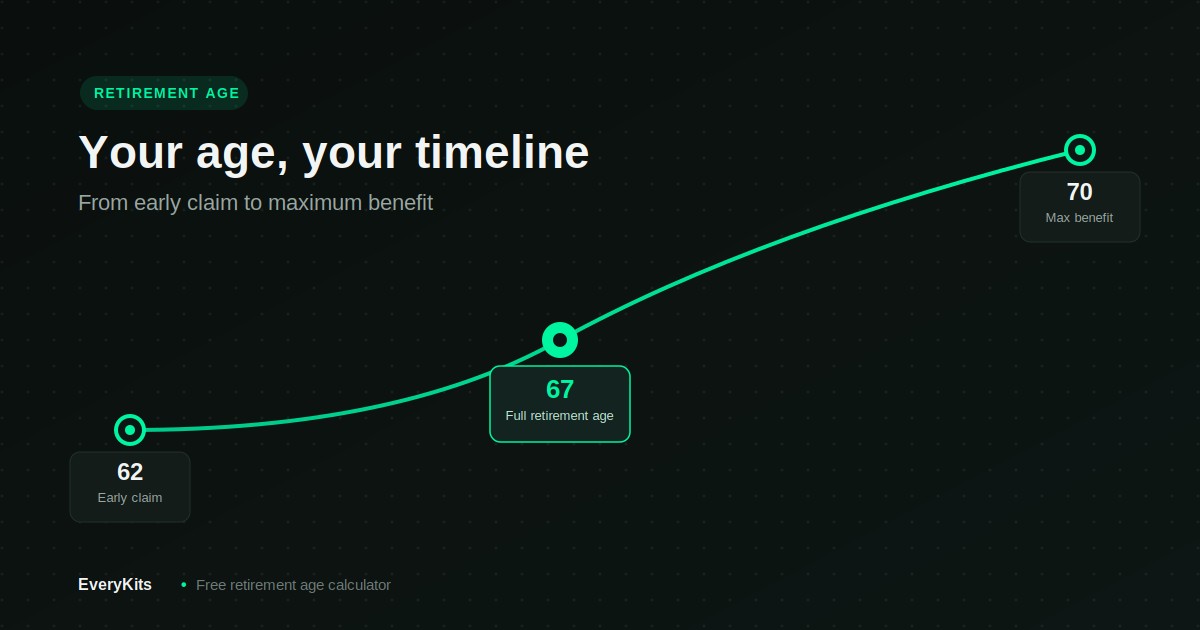
Your Full Retirement Age is 67, which you'll reach in 2037. You can claim reduced benefits starting at 62 (in 2032), or wait until 70 (2040) for the maximum possible monthly benefit. - Claiming at your FRA (67): you receive 100% of your calculated benefit, with no reduction or bonus.
- Delaying until 70: your benefit grows to roughly 124% of your full amount, thanks to delayed retirement credits that accrue at about 8% per year past FRA.
There's no benefit to waiting beyond 70 — delayed retirement credits stop accruing at that point, so 70 is effectively the ceiling for maximizing your monthly payment. The right age to actually claim depends on your health, other income sources, and whether you're married, since spousal and survivor benefits are calculated off your FRA amount regardless of when you personally claim.
What About Pakistan, India, or the UK?
The chart above reflects the US Social Security system specifically. Government retirement ages elsewhere follow entirely different rules — for example, government employees in both Pakistan and India retire at a fixed 60 years regardless of birth year, while the UK State Pension age is currently transitioning from 66 to 67. If you're outside the US, the retirement age calculator includes a country reference table covering these systems, since the birth-year logic above won't apply the same way outside the US.
Frequently Asked Questions
Is retirement age now 66 or 67?
Born in 1971 — when can I retire? Same FRA of 67, reached in 2038. Early eligibility starts at 62 (2033), and delayed retirement credits stop accruing at 70 (2041).
Born in 1972 — when can I retire? FRA of 67, reached in 2039. Earliest claiming age is 62 (2034); the latest point where waiting still increases your benefit is 70 (2042).
Born in 1973 — when can I retire? FRA of 67, reached in 2040. You become eligible for early, reduced benefits at 62 (2035), with the delayed-credit window closing at 70 (2043).
Born in 1980 — when can I retire? FRA of 67, reached in 2047. Early claiming opens at 62 (2042), and the benefit-boosting delay window runs through 70 (2050).
Notice the pattern: for every birth year from 1960 onward, the math is the same — Full Retirement Age is 67, early eligibility is 62, and the maximum-benefit delay point is 70. Only the calendar years shift depending on when you were born. If your birth year isn't listed above, the retirement age calculator will give you the same breakdown instantly for any date of birth.
Early vs. Full vs. Delayed Retirement — What Changes
Claiming before or after your Full Retirement Age doesn't just change when you get paid — it permanently changes how much you get paid every month for the rest of your life. For someone with an FRA of 67:
- Claiming at 62 (the earliest possible age): your benefit is permanently reduced to roughly 70% of your full amount.
Can I retire at 62 if I was born in 1970? Yes. Age 62 is the earliest age Social Security allows you to claim retirement benefits, regardless of your birth year. The trade-off is a permanent reduction — for someone with an FRA of 67, claiming at 62 locks in roughly 70% of the full benefit rather than 100%.
Does my Full Retirement Age change if I keep working past it? No — your FRA itself is fixed by birth year and never changes. What can change is your benefit amount, since continuing to work can replace lower-earning years in your benefit calculation and increase your Primary Insurance Amount.
Why is my FRA different from a friend born just a few years earlier? Full Retirement Age rose gradually rather than jumping straight from 65 to 67. Anyone born 1955 through 1959 falls in the phase-in window, gaining two extra months of FRA for each birth year in that range, which is why small birth-year gaps can produce different FRAs.
Is this the same as my company's retirement age? Not necessarily. Full Retirement Age is specifically about Social Security eligibility, not employer policy. Many people retire from their jobs earlier or later than their FRA and simply time their Social Security claim separately from their last day of work.
Find Your Exact Date
Knowing your Full Retirement Age is the starting point, but your actual retirement date depends on your specific date of birth. Head over to the retirement age calculator and enter your birth date to get your projected date instantly — or, if your pension is based on years of service rather than a fixed age, switch to the "By Years of Service" tab to check your Rule of 80/85/90 eligibility instead.



Comments
Comments coming soon! In the meantime, feel free to share your thoughts on social media.